

A diaphragm valve does not move the way a ball or butterfly valve does. Instead of a 90-degree turn, it needs controlled travel along a straight axis, lifting the compressor and diaphragm to open the flow path, and pressing the diaphragm onto the weir to seal. That is why diaphragm valves take linear actuators rather than the rotary units you would fit to a quarter-turn valve.
Specified correctly, a pneumatic actuator gives you repeatable operation, remote control, position feedback into the control system and a defined position on air failure. Specified badly, it either cannot generate enough force to seal, or it moves the wrong way when the air goes.
Sizing: Thrust, Stroke and Seat Load
The actuator has to produce enough usable thrust across its whole stroke, not just at its rated maximum. Available force varies with design, operating air pressure, spring arrangement and position in the stroke, so assess the full operating duty rather than a single headline figure.
Required thrust
What drives it:
- Process pressure acting across the valve
- Force needed to compress the diaphragm onto the weir
- Friction in the valve and actuator assembly
- Spring force, in a fail-safe actuator
- Variation in instrument air pressure
- Any safety margin the application demands
Tell us the maximum differential pressure the valve may see, not just its normal operating pressure. And for an air-operated closing movement, the actuator has to work at the minimum guaranteed air pressure – size it around the compressor’s normal output and you will find the valve failing to seal on the days when site air demand peaks. For a fail-closed arrangement, the spring alone has to close the valve and hold shut-off with the air removed.
Stroke compatibility
Actuator stroke has to match the travel the valve needs. Too little and the valve never reaches full open, or never generates an effective seal. Too much, or badly adjusted, and you are putting avoidable stress into the diaphragm and shortening its life.
The actuator, spindle, compressor and diaphragm attachment all have to be mechanically compatible, which matters most when you are retrofitting to an existing valve or changing diaphragm fixing style.
Diaphragm seat load
A diaphragm valve seals through controlled compression between diaphragm and weir. Too little load leaks. Too much deforms or splits the diaphragm.
Correct loading depends on valve size, line pressure, diaphragm construction and the manufacturer’s design. Rubber and PTFE-faced diaphragms can need different compressor arrangements or force characteristics entirely, so we will not apply a generic sizing figure without checking the specific valve, actuator and diaphragm combination. If you are unsure which diaphragm grade you have, the diaphragm spares range is a useful reference point. See also our hygienic and aseptic diaphragms and industrial diaphragm valve range.
Choosing the Failure Action
Air-to-open and air-to-close describe which way air moves the valve. The question that actually matters is what the valve does when the air is removed.
Air-to-open, spring-to-close. Air opens the valve against a closing spring; losing air closes it. Choose this where stopping flow is the safer response – shutting off a chemical feed, preventing uncontrolled transfer, isolating part of a process when control power goes.
Air-to-close, spring-to-open. Air closes the valve against an opening spring; losing air opens it. Choose this where maintaining flow matters – cooling, drainage, circulation, or another defined safety function.
Double acting. Air drives both directions, one connection each way. Powered movement throughout, useful where you do not need a mechanical spring position and where cycle frequency or speed makes powered closing worthwhile. The limitation is that losing air leaves the valve wherever it was, or wherever process forces push it. If a defined failure response is essential, you need stored air, additional pneumatic control, or a spring-return actuator instead.
Neither fail direction is inherently safer. Work it out from the process: loss of instrument air, loss of electrical power, solenoid failure, control signal failure, and what an unintended open or closed valve would actually do. Then specify the position that leaves the process safest.
One drafting point worth insisting on. Avoid “normally open” and “normally closed” in a specification. They can refer to the process state, the spring position or the solenoid state, and the three do not always agree. Write “air-to-open, spring-to-close” instead. It is longer and it cannot be misread.
Spring selection is not an afterthought either. Different spring packs suit different valve sizes, diaphragm types and line pressures, and the spring has to deliver its required force at the end of the stroke, not just move the valve in the right direction. It also has to be overcome during the powered stroke, so it affects thrust and air consumption both.
Control Integration: Solenoids, Switchboxes and Feedback
An automated diaphragm valve is rarely just valve plus actuator. Expect to specify a solenoid, tubing and fittings, flow controls, position indication and a route into the PLC, DCS or SCADA system.
Solenoid selection
The solenoid directs instrument air to the actuator on an electrical signal. Define supply voltage and electrical connection, port size and flow capacity, single or double solenoid operation, manual override, ingress protection, ambient temperature, hazardous area requirements, and, critically, the required de-energised position, which must agree with the actuator’s fail direction.
Where a NAMUR-style interface is available, mounting the solenoid directly to the actuator removes external tubing and gives you a more compact, more robust assembly than remote pipework.
Position feedback
A visual indicator is enough where someone checks the valve locally. Automated sequences need an electrical signal confirming the valve reached position, which is what a switchbox provides through mechanical switches or proximity sensors.
Feedback lets you confirm commanded movement, support interlocks, stop the next stage of a sequence starting early, alarm on a valve that fails to reach position, and log valve activity. Decide in the control philosophy whether you need open confirmation, closed confirmation or both.
An important limit. Position feedback confirms the actuator moved. It does not prove the diaphragm has made a pressure-tight seal. If your process needs seal integrity demonstrated, that is a separate test, not something a switchbox tells you.
Our own Phase LCSB switchbox fits the Phase LC actuator and Saunders EC, SSC and S360 actuators in spring close, spring open and double acting variants. It takes one or two SPDT switches, silver as standard or gold optional, or one or two sensors in two-wire NAMUR, two-wire PNP/NPN, three-wire PNP or three-wire NPN – so an existing Saunders installed base can usually be brought onto a common feedback standard without changing the valves.
Hygienic and Washdown Service
In food, beverage, pharmaceutical and biotech installations the actuator is part of the hygienic system, not just a pneumatic device bolted on top of one.
External cleanability. A compact, smooth profile reduces dirt traps. Review the whole assembly for exposed threads, deep recesses, horizontal ledges, places cleaning fluid can sit, and fasteners nobody can reach. Be realistic about drainability though – that depends on body, pipework, installation angle and orientation, and no actuator design compensates for an arrangement that traps fluid.
Materials and finish. Establish requirements for wetted and non-wetted components separately. Stainless housings suit washdown, cleanroom and autoclave environments; alternative enclosure materials are fine where cleaning is less aggressive. Specified product-contact finishes normally apply to the body and wetted parts, but external finish matters too if the equipment is cleaned frequently or sits in a controlled production area.
Elastomer compatibility. Actuator seals and diaphragms have to survive the process fluid, the cleaning chemicals, the operating temperature, steam exposure, sterilisation and the expected cycle count. A material that performs perfectly in production can degrade fast under repeated caustic, acid or steam exposure – so give us the cleaning conditions alongside the process conditions, including any CIP, SIP or autoclave regime.
Documentation for Validated Environments
In regulated environments the documentation is part of the deliverable, and records not created during manufacture, assembly or testing are difficult to reconstruct afterwards. Agree the package before ordering.
Typically: approved datasheets and drawings, material and traceability certificates, diaphragm or elastomer certificates, assembly and pressure test records, switch calibration records, declarations of conformity, tagging and asset schedules, and Installation and Operational Qualification support.
Split the responsibilities explicitly. We can supply test evidence and supporting records; the validation exercise itself stays specific to your system and your quality arrangements. We support hygienic valve, actuator and control equipment projects across the life science and pharmaceutical sector.
Worked Example: Automating a DN25 Weir Valve
An existing DN25 weir-type diaphragm valve needs converting from manual to automated operation. The process requires it to close on loss of instrument air, and the control system needs confirmation of both positions.
First we confirm the valve itself, manufacturer, nominal size, pressure rating, diaphragm grade and fixing style, and check the bonnet interface, spindle and compressor arrangement will take a pneumatic conversion. Then the design conditions: medium, normal and maximum differential pressure, temperature, cleaning regime, and the minimum available instrument air pressure.
Because the safe position is closed, that gives us an air-to-open, spring-to-close actuator, with a spring pack matched to the valve size, diaphragm and maximum differential pressure. A compatible solenoid admits air to open and releases it for spring closure. A switchbox returns open and closed confirmation. We then check housing, seals and any stainless requirement against the process area and cleaning method, and finally agree assembly testing, switch calibration, material documentation and tagging in the purchase specification.
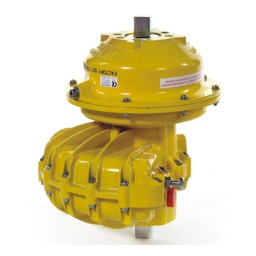
The Phase LC actuator is our own answer to this duty – a lightweight, compact linear unit built for high-integrity diaphragm valve actuation, available in spring-close, spring-open and double-acting configurations, with four mounting holes for accessories such as the LC switchbox. It suits weir-type valves from DN8 to DN50 and can replace a compatible manual bonnet as well as forming part of a new assembly. Published operating air pressure is 6 barg normal, 8 barg maximum. Like everything in the Phase range, it is made in Britain at our Birkenhead works.
Note where the model choice came in the process: last. Application, valve compatibility, failure action and control requirements first, then the actuator. Reverse that order and you get an actuator that fits mechanically and fails operationally. There is more on how we build for reliability if that is useful.
What to Send Us
The more of this we have up front, the less back-and-forth before you get a firm recommendation:
- Valve manufacturer, type, nominal size, body pattern and pressure rating
- Diaphragm material and fixing style
- Process medium and temperature
- Normal and maximum differential pressure
- Minimum available instrument air pressure
- Required operating position and required failure position
- Expected cycle frequency, and any opening or closing speed requirement
- Solenoid voltage and configuration
- Position feedback requirements – open, closed or both
- Environmental or hazardous area classification
- Washdown, CIP, SIP or autoclave conditions
- Required testing and documentation
Talk to Us About a Diaphragm Valve Actuator
We can specify actuators for new diaphragm valve assemblies or convert suitable manual valves to pneumatic operation, including on installed Saunders valves. Send the valve details, process conditions, available air pressure, required failure position and control requirements, and we will come back with an actuator, solenoid and position-monitoring package we can justify. Contact us today!
Call 0151 488 7222 or email info@heaps.co.uk.