

We are a British valve manufacturer, and we are not a relief valve manufacturer. Both facts matter if you are looking for a UK source of pressure relief, so we will be clear about them up front.
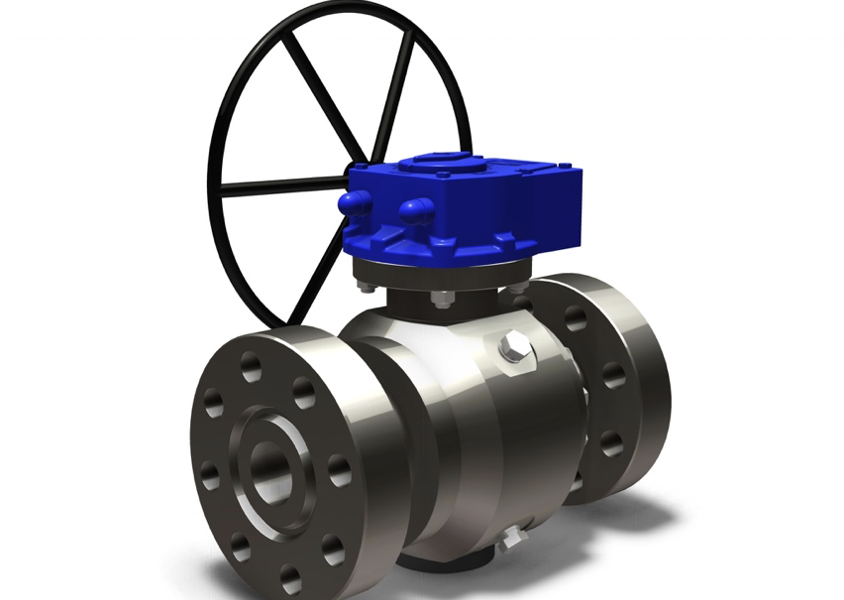
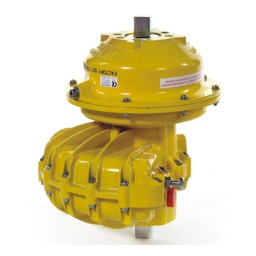
We have designed, manufactured and supplied industrial flow control equipment from Birkenhead since 1866. Our research, design and manufacturing operations are covered by ISO 9001:2015, and our own Phase range is machined, assembled and tested at Canada Works on the Wirral – from mounting kits, switchboxes and distribution manifolds through check valves and hygienic diaphragm valves, up to high pressure, high temperature trunnion mounted ball valves.
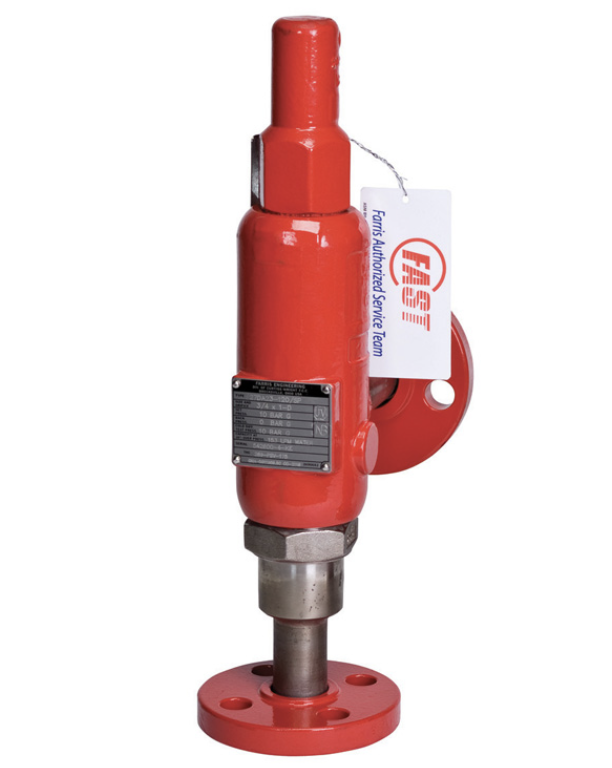
For pressure relief we supply Farris, part of Curtiss-Wright, and a world leader in spring-loaded and pilot-operated relief valves, alongside Fike rupture discs. What we add is the engineering: sizing and selection, material and trim specification, configuration and finishing at our own works, certification management, and the documentation package your project has to pass.
The result is relief valves with genuine ASME and National Board certification behind them, specified by engineers who manufacture pressure-retaining equipment themselves. Farris valves are available across the full set pressure range, in flange standards including ANSI, API, MSS, BS, PN and ISO, and in materials from carbon and stainless steel through duplex and super duplex to aluminium bronze, Monel, titanium and zirconium. We support safety relief valve requirements across chemical processing, water and utilities, oil and gas, nuclear, power generation and life science.
What to Send Us for a Relief Valve Enquiry
Send us as much of the following as you have and we will review the design conditions rather than come back with a list of questions:
- Fluid name and composition, and whether it is gas, vapour, steam, liquid or two-phase
- Required set pressure and normal operating pressure
- Relieving temperature
- Required relieving capacity, and how it was calculated
- Inlet and outlet sizes, pressure ratings and flange facing
- Built-up and superimposed back pressure
- Preferred body, trim and seat materials, and any material restrictions
- Applicable design code and certification requirements
- Final installation country – this determines the conformity route
- Required documentation package
- Quantity, delivery date, and any inspection or witness points
If the relieving capacity has not been calculated yet, send the protected equipment details and the credible overpressure scenario instead and we will work through it with you. Do not estimate capacity from the existing connection size – it is the most common route to an undersized valve.
The Ranges We Supply
Farris 2600 and 2600L Series. The most adaptable of the three. A single design handles air, steam, vapour and liquid service, and the valve converts between conventional and bellows construction, metal and soft seat, and vapour and liquid trim with a minimum of parts – which cuts the spares you hold and makes conversion cheap if a duty changes.
Farris 2700 Series. A process valve built for breadth of sizes, orifices and materials. Balanced design in the C and D orifices nullifies back pressure, a built-in lift stop keeps performance stable, and fixed blowdown simplifies testing. Where seat tightness matters, the optional O-ring seat delivers zero bubbles per minute at 90% of set pressure to API 527. Connections run from threaded through flanged, socket weld, welding nipple and sanitary.
Farris 3800 and 3800L Series. Pilot-operated, and conforming to API 526. Because it stays bubble tight much closer to set pressure than a conventional spring-loaded design, you can run the process nearer to maximum allowable working pressure – more throughput, lower fugitive emissions and less product loss. Snap acting or modulating control, semi and full port nozzle designs.
Fike rupture discs. For vapour and liquid media across high and low pressures, including hygienic environments. A rupture disc is sometimes the right primary device and often the right thing upstream of a relief valve – isolating it from a corrosive or polymerising medium, or providing secondary protection. We will tell you when one is unnecessary as readily as when it is essential.
Thermal relief. Where trapped liquid can expand against a closed system, the required capacity is tiny but the consequence of fitting nothing is not. A full process relief valve is usually the wrong tool and an expensive one – see thermal relief valves and what they are for.
Browse by type: process safety valves, steam safety valves and speciality safety valves.
Our Birkenhead Works
Canada Works on Corporation Road is where our UK manufacturing happens, under ISO 9001:2015 across design, research and production. Recent investment includes a five-axis machining centre, 3D printers for rapid prototyping and our first production robot – which is how we designed, produced and launched three new products from scratch in six months.
The Phase range runs from mounting kits and switchboxes through check valves, Class 150 and 300, 15mm to 100mm, 316 stainless with Inconel springs, up to trunnion mounted ball valves. We designed and manufactured twelve of those for a Serica Energy maintenance campaign at the Bruce Field facilities in the UK North Sea.
Farris valves are specified and configured to order here, then finished and painted to your own scheme before dispatch. A recent example: Farris 2600 Series, 2″ #1500 RTJ inlet by 3″ #300 RF outlet, H orifice, WC6 body with 316 stainless steel trim and a Stellited nozzle and disc. Set pressure, test medium, test standard and acceptance criteria are confirmed in writing before anything is configured – along with tagging, paint systems, material restrictions and inspection points.
Certification
Requirements vary with the valve, the protected equipment, the destination market and the client specification, so we establish them at quotation stage. Documents agreed late are the commonest cause of delay on relief valve orders.
Material traceability. Where BS EN 10204 3.1 inspection certification is required, your order should identify which pressure-retaining or wetted components it covers. We maintain traceability between certificates, components and the completed assembly, including across our own Phase products, where 3.1 is available on request.
ASME and National Board. Selected Farris relief valves carry ASME and National Board certification for defined media and applications, with the exact model, code section and certified capacity confirmed during selection rather than assumed across a series. To be precise about our position: that certification is Curtiss-Wright’s, held as manufacturer. We supply certified products and manage the documentation, we do not stamp relief valves ourselves. More on what ASME Section VIII covers.
UK and EU conformity. Pressure equipment placed on the market in Great Britain must meet the Pressure Equipment (Safety) Regulations 2016, and may carry UKCA or CE marking depending on the route to market. Northern Ireland, the EEA and international destinations differ – tell us the final installation location at enquiry stage and we will confirm which regime applies before you commit to a specification.
Documentation and Asset Records
Agree the documentation requirement with the technical specification, before the order is placed. Depending on the project a package may include:
- Approved datasheets, order acknowledgements and general arrangement drawings
- Material inspection certificates to the agreed EN 10204 type
- Pressure and seat test certificates, set pressure and certified capacity information
- Declarations of conformity
- Welding, coating and non-destructive examination records
- Tagging schedules, asset lists and inspection and test plans
- Installation, operation and maintenance instructions
- Installation Qualification and Operational Qualification documentation
We can also hold valve records digitally through ValveCloud, so the information stays accessible after the project team has moved on, which matters when you come to review certification or plan replacement years later.
Sector Requirements
The purpose of a relief valve does not change between industries. The specification priorities do.
Chemical – media compatibility, corrosion and the consequences of discharge drive material selection well beyond the body. Tell us concentration and temperature as well as fluid; crystallisation and polymerisation change the answer. Chemical industry.
Water and utilities – corrosion, outdoor exposure, intermittent operation and treatment chemical compatibility. Across AMP-cycle programmes, standardised tagging and parts availability matter as much as the valve. Water industry.
Oil and gas – specialist materials, sour service restrictions, fire-safe design and fugitive emissions, with back pressure and the disposal system resolved alongside the relief case. Oil and gas.
Nuclear – traceability, configuration control and document retention first; inspection stages and witness points often drive lead time harder than manufacture. Phase products are supplied into nuclear duties. Nuclear industry.
Life science – hygienic materials, cleanability and controlled surface finishes, with IQ and OQ contents and approval route defined before supply. Life science.
Talk to Us About a Relief Valve Requirement
Send us the set pressure, relieving temperature, fluid, required capacity and the certification package you need to satisfy, and we will review the design conditions and come back with a specification we can justify, or tell you what we still need to know.
Call 0151 488 7222 or email info@heaps.co.uk. You can also browse the safety relief valve range or read more about Heap & Partners.