

Precision valve control across the pharmaceutical process system
Pharmaceutical manufacturing is a discipline that demands consistency above almost everything else. Batch-to-batch repeatability, full traceability of every material and component, and the ability to demonstrate through documented evidence that a system performs as designed – these are not optional aspirations. They are regulatory requirements that determine whether a product reaches patients.
Two types of valve hardware underpin the fluid handling systems in any modern pharmaceutical facility: the automated process valves that control flow in and out of tanks, vessels, and skids; and the precision instrumentation valves that manage gases, analytical sampling lines, laboratory utilities, and high-integrity isolation points. Both categories demand the same quality of specification – but they are often supplied by different routes and evaluated against different criteria.
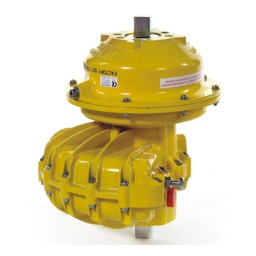
We bring both together. Our Phase LC Actuator is our own product, designed and built at our Birkenhead facility, for diaphragm valve automation in pharmaceutical process systems. Parker Instrumentation – whose valves, fittings, and tubing we supply across the UK – provides precision engineering for analytical lines, gas systems, high-purity fluid handling, and instrumentation panel assemblies. This article covers how both product ranges serve pharmaceutical manufacturing and what to consider when specifying either.
The Phase LC Actuator in pharmaceutical process systems
Automated diaphragm valves are the building blocks of pharmaceutical fluid handling. On any WFI distribution loop, CIP skid, bioprocessing train, or sterile filling system, the combination of a weir-type diaphragm valve body and a pneumatic actuator provides on/off control that is both hygienic and auditable. The actuator converts a pneumatic signal from a solenoid or control system into a defined, repeatable mechanical action – closing the diaphragm against the weir seat with consistent force and releasing it to a defined open position on command.
Our Phase LC Actuator was designed specifically for this application. It is a linear compact actuator for weir-type diaphragm valves in sizes from 8 mm to 50 mm, compatible with both Phase diaphragm valve bodies and Saunders diaphragm valves – the two most widely installed weir diaphragm valve ranges in the UK pharmaceutical sector. This cross-compatibility means that if your plant runs a mixed population of valve bodies, you can standardise on the Phase LC Actuator without forcing a valve body replacement programme.
Design features that matter in pharmaceutical environments
The actuator uses direct mounting to the valve body, eliminating any gap or bracket that could create a misalignment condition over time. Misalignment in diaphragm valve actuation is a well-documented failure mode: it places asymmetric load on the diaphragm, accelerates wear, and can lead to incomplete closure – a non-conformance event in any validated system.
The glandless design removes the stem seal from the picture entirely. There is no gland packing to adjust, no emission path from the mechanism to the surrounding environment, and no maintenance schedule associated with stem sealing. For pharmaceutical environments where maintenance access to operational systems is managed carefully and any activity near process lines requires risk assessment, reducing the number of maintenance-intensive components is a meaningful simplification.
The smooth external profile of the actuator reduces surface area that requires hygienic wiping between uses. Where the actuator is mounted inside a cleanroom or hygienic enclosure – as is routine on aseptic filling lines and contained bioprocessing skids – this matters. Internal surfaces of cleanroom enclosures are validated for cleanability, and projecting actuator housings with recesses or protruding bolt heads complicate that validation.
For environments requiring sterile conditions, the stainless steel housing version is autoclavable. Position indication is integrated as standard, and the four mounting holes for the companion Phase LCSB Switchbox allow discreet position feedback – open, closed, or intermediate – to be wired back to the plant DCS or SCADA system without additional bracket assemblies. For more detail on the full LC Actuator specification, see our Phase LC Actuator engineering reliability article.
Fail-safe configuration in pharmaceutical systems
Pharmaceutical automated valve specifications almost always specify a defined fail-safe position. The default for most process isolation valves on product or WFI lines is air-to-open/fail-closed: if instrument air is lost, the valve closes automatically, isolating the process and preventing uncontrolled flow. The Phase LC Actuator is available in this configuration as standard, with double-acting as an alternative where the process requires defined fail-open behaviour – for example, on cooling water or vent lines where closure on air failure would create a more hazardous condition than remaining open.
Both configurations are available and can be specified at the time of order. If you are automating a mixed panel of valve sizes with different fail-safe requirements, talk to us about the actuator sizing across the range before committing to a bill of materials — we can confirm compatibility across the 8–50 mm size range and identify any special arrangements needed for larger or higher-pressure valves.
Parker Instrumentation in pharmaceutical manufacturing
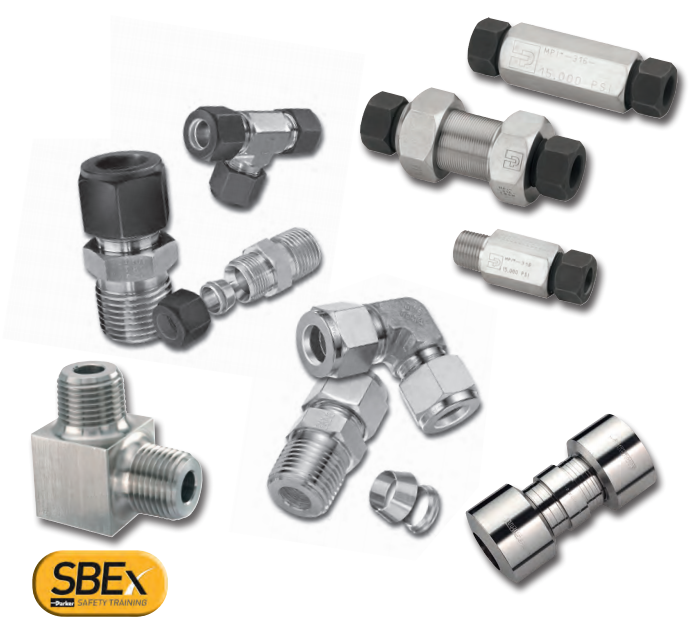
While diaphragm valve actuation addresses the process side of pharmaceutical fluid handling, Parker Instrumentation covers the precision and analytical layers – gas distribution systems, instrument sample lines, high-purity chemical handling, laboratory gas panels, and chromatography systems. Parker’s instrumentation product range is one of the most comprehensive in the market: needle valves, ball valves, check valves, manifolds, tubing, and fittings, available in configurations from low pressure to ultra-high pressure. You can browse our full Parker Instrumentation valves and manifolds range for the complete product listing.
Parker’s CO Series check valves are specifically designed for uni-directional flow control in pharmaceutical, research, and microelectronics applications – preventing backflow in sensitive analytical lines where contamination or pressure reversal would compromise sample integrity or instrument performance. The MAB Series ball valves are available as manual, pneumatic, and electrically actuated two-way and three-way configurations, covering both isolation and switching duties on pharmaceutical gas and fluid distribution panels up to 15,000 psi.
Parker Instrumentation materials for pharmaceutical service
Parker Instrumentation valves are available in 316 stainless steel throughout, which is the standard material for pharmaceutical utility lines and instrument assemblies. For applications in direct contact with corrosive or reactive process streams – aggressive solvents, halogenated compounds, or oxidising agents – Parker’s Partek and Parflex divisions provide fluoropolymer-based valves, fittings, and tubing with FDA compliance and USP Class VI elastomers where required. Our Parker instrumentation fittings page covers the full fittings range including compression, tube, and NPT connection styles.
The precision machining and materials traceability of Parker Instrumentation products support the documentation requirements of validated pharmaceutical systems. Material test reports and dimensional records are available for inclusion in qualification packages, which reduces the administrative burden of sourcing certified components from multiple vendors.
Common pharmaceutical applications for Parker Instrumentation
The applications where Parker Instrumentation products are most frequently specified in pharmaceutical manufacturing include compressed gas distribution – nitrogen, compressed air, and inert gas blanket systems – where leak integrity and consistent pressure regulation are critical. For nitrogen generation on-site, we also supply Parker nitrogen gas generators, which pair naturally with Parker’s downstream instrumentation valves and regulators.
Other key applications include analytical and process sampling systems, where needle valves and check valves isolate sample points and prevent contamination of reference streams; and laboratory instrument panels and reagent delivery systems, where small-bore instrumentation tubing, high-integrity fittings, and precise flow control are the design basis.
Parker’s instrumentation regulators are widely used in pharmaceutical contexts for maintaining consistent gas pressures on chromatography systems, autoclave gas circuits, and pressure vessels used in downstream processing. Our Tescom regulator range – also from Parker – extends this precision pressure control capability into higher-pressure gas applications where tighter set-point stability is required.
How the two ranges complement each other on a pharmaceutical project
On a typical pharmaceutical manufacturing project, the Phase LC Actuator and Parker Instrumentation products often appear on the same P&ID but on different line categories. The Phase LC Actuator is on the process lines – the WFI loop, the CIP main, the media transfer connections, the fermentation feed lines. Parker Instrumentation is on the utility and instrument lines – the instrument air sub-headers, the sampling connections, the gas panel of the bioreactor, the analytical loop on a water quality monitor.
Sourcing both from Heaps means a single point of contact for technical specification, material documentation, and delivery. For pharmaceutical procurement teams managing a large bill of materials across multiple vendor categories, reducing the vendor count without compromising on product quality or coverage has real administrative value – particularly during the IQ phase of a project when documentation chase-up can consume significant QA resource.
We also have the technical depth to span both ranges. Our team can advise on actuator sizing, diaphragm selection, and fail-safe configuration for the Phase LC Actuator in the same conversation as Parker needle valve sizing for a sampling panel or fitting selection for a clean gas distribution manifold. You do not need to route those queries through two separate distributors. For a sense of the breadth of the Parker Instrumentation portfolio we carry, see our Parker instrumentation manifold article.
What to tell us when you are specifying
For the Phase LC Actuator:
- Valve body size and manufacturer (Phase or Saunders, 8–50 mm)
- Diaphragm type – screw-fixed or bayonet-fixed, and elastomer grade (EPDM, PTFE, Viton, etc.)
- Line pressure and fluid type
- Control requirement – air-to-open/fail-closed or double acting
- Instrument air supply pressure available at point of use
- Position feedback requirement – Phase LCSB Switchbox, NAMUR, or none
- Environmental conditions – cleanroom, autoclave, washdown, or standard
- Port standard – BSPP or NPT
For Parker Instrumentation products:
- Application type – isolation, check, regulation, or switching
- Operating pressure range – working and maximum design
- Fluid or gas type – including any FDA, USP Class VI, or chemical resistance requirements
- Connection type and size – NPT, compression, or Parker MPI tube fitting
- Actuation requirement – manual, pneumatic, or electric
- Material requirements and certification level – standard or 3.1 material test reports
- Required documentation for IQ/OQ support
We are experienced in working to pharmaceutical documentation requirements – material certificates, pressure test records, surface finish data, dimensional records – and can build the documentation package as part of the supply process rather than as an afterthought. If your project has a specific vendor documentation requirement or qualification protocol, send it to us at the start of the enquiry and we will align our supply documentation to it.
Speak to our technical team
Whether you are specifying a new pharmaceutical manufacturing facility, automating an existing manual diaphragm valve inventory, or sourcing Parker Instrumentation products for a laboratory or process gas system, we are here to help. Call us on 0151 488 7222 or email info@heaps.co.uk. Our offices in Birkenhead, Teesside, and Dublin serve pharmaceutical clients across the UK and Ireland.