

Valve actuation and overpressure protection: two sides of the same compliance challenge
If you work in pharmaceutical manufacturing, you already know that every component in a process system has to earn its place. Materials of construction, surface finish, cleaning compatibility, documentation – all of it is scrutinised before a valve or actuator is released for use on a validated system. What is sometimes treated as two separate procurement decisions – process valve actuation and pressure relief – frequently comes down to the same criteria: integrity, repeatability, and the ability to demonstrate compliance across the lifecycle of the plant.
We supply both elements. Our Phase LC Actuator is our own in-house product, designed and manufactured at our facility in Birkenhead and specifically engineered for diaphragm valve automation. Alongside it, we offer Farris pressure relief valves from Curtiss-Wright – a name that has protected pharmaceutical processes worldwide for over 80 years. This article explains where each product sits in a pharmaceutical system, why the selection criteria matter, and what to bring to us when you are specifying either.
Why diaphragm valves dominate pharmaceutical fluid handling
The diaphragm valve is the default choice for pharmaceutical process and utility lines – purified water (PW), water for injection (WFI), clean steam, buffer and media transfer, CIP return, and direct product contact – for reasons that are directly tied to cGMP requirements.
The design provides a complete physical separation between the process fluid and the valve actuating mechanism. There are no stem seals in contact with the fluid path, no lubricant-wetted parts that could shed into the product, and no internal cavities that resist drainage or cleaning. For WFI systems in particular, where endotoxin control is critical and even trace contamination of the fluid is a regulatory event, this separation is not a convenience – it is a design requirement.
When correctly specified and installed, a weir-type diaphragm valve supports CIP and SIP without disassembly, meets ASME BPE dead leg requirements, and provides a flow path that is both smooth and auditable. The diaphragm itself – selected from EPDM, PTFE, or other compliant elastomers – becomes a controlled-change, documented-replacement component with a defined service life. We stock Phase EPDM diaphragms and TFM/PTFE diaphragms to support both grades.
Automation of these valves using a pneumatic actuator adds the repeatability that modern pharmaceutical production demands. Manual valve operation introduces variability into sequenced processes; actuated valves can be controlled precisely, monitored for position, interlocked with safety systems, and incorporated into batch records. On any automated skid – WFI distribution, CIP station, bioprocessing, filling – the actuator is as much a part of the system design as the valve body.
The Phase LC Actuator: what it is and why it was designed this way
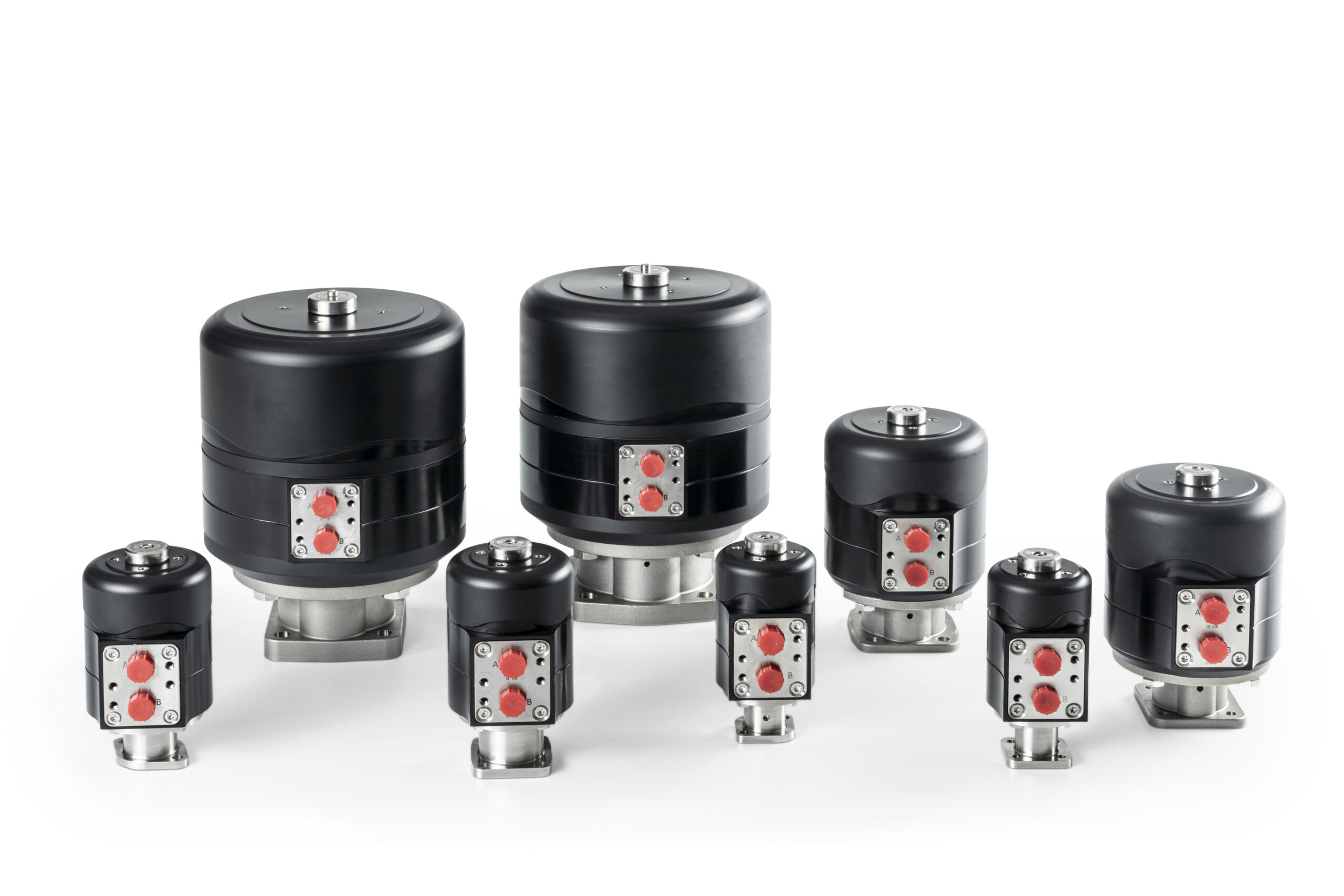
The Phase Linear Compact (LC) Actuator is our own product, designed, built, and tested in Birkenhead. It is a pneumatic linear actuator for weir-type diaphragm valves in sizes from 8 mm to 50 mm. We developed it to address a gap in the market for a hygienic, compact, cost-effective actuator that could be specified from new or retrofitted to existing manual valve bodies in the field – including both Phase diaphragm valve bodies and Saunders diaphragm valves.
The core design decisions all point in the same direction. The actuator uses a direct-mounting arrangement that eliminates any risk of misalignment between the actuator and the valve body. Misalignment on a diaphragm valve is not just a mechanical problem – it affects diaphragm loading, compressor life, and ultimately the leak-tightness of the closure. Direct mounting removes that variable.
The glandless design means there are no stem glands to maintain and no potential emission path from the actuating mechanism into a clean environment. The smooth external profile of the actuator body – with no unnecessary projections or recesses – reduces the surface area that requires wiping down between operations, which matters when the actuator is mounted in a cleanroom or hygienic enclosure.
Where pharmaceutical environments demand it, the stainless steel housing version is autoclavable, supporting validated sterilisation of the actuator alongside the valve assembly. Position indication is built in as standard, with four mounting holes for the companion Phase LCSB Switchbox when position feedback to a control system or DCS is required.
Key specifications at a glance
The Phase LC Actuator operates at 6 bar g working supply pressure and is available in air-open/fail-closed and double-acting configurations. The spindle is 316 stainless steel throughout. The Namur mounting plate – also 316 SS – allows direct solenoid mounting and accommodates 1/8″ BSPP ports as standard, with NPT available as an option. Seals are nitrile as standard, with Viton available for processes involving aggressive media or elevated temperatures. If you need a solenoid to drive the actuator, our Lucifer solenoid valve range mounts directly to the Namur plate.
Where Farris pressure relief valves fit into the same system
No pharmaceutical production facility operates without overpressure protection. Wherever you have a pressurised vessel, a reactor, a steam jacketed tank, a WFI still, a heat exchanger, or any closed fluid system, you need pressure relief. The question is not whether to fit it – the regulatory and engineering requirements make that mandatory – but how to select and specify it correctly. Our guide to pressure relief valves explained covers the fundamentals if you need a starting point.
Farris, part of Curtiss-Wright, has been designing and manufacturing spring-loaded and pilot-operated pressure relief valves since the early 1940s. That heritage matters in pharmaceutical procurement because it means the Farris product range is not new to the standards, materials, and documentation expectations of the industry. Farris PRVs are deployed across pharmaceutical processing worldwide, on gas, air, water, vapour, liquid, and steam service.
We stock and supply the Farris range including the 1890/1896 Series, the 2600 and 2700 Series, and the pilot-operated 3800 Series. All are available with full ASME/NB certification and CE marking, and in a complete range of construction materials – including 316 stainless steel, Duplex, Super Duplex, Monel, Hastelloy, and Titanium – covering the material traceability expectations of pharmaceutical procurement.
Selecting the right Farris series for pharmaceutical applications
For most pharmaceutical process utility applications – steam lines, heat exchangers, WFI stills, buffer tanks – the Farris 2600 Series is the starting point. These are flanged, spring-loaded valves certified to ASME Section VIII, available in 316 SS trim and suitable for water, steam, gas, and air service. Where back pressure is variable or where the process fluid must not contact spring internals, the balanced bellows variants in the 2700 Series provide the answer – our article on thermal relief valves and the Farris 2700 Series explains the selection rationale in detail.
For larger or more demanding installations – reactors, pressurised extraction systems, high-pressure clean steam headers – the pilot-operated 3800 Series delivers tighter blowdown control (typically 3-6%) and a wider operating pressure range up to 6,170 psig. In pharmaceutical manufacturing, where processes may operate close to their design pressure, the ability to run at 98% of set pressure without premature opening is operationally significant: it reduces unnecessary relief events and the product losses or cleaning cycles they can trigger.
All Farris series are supported by Farris SizeMaster™ – the manufacturer’s own web-based sizing and selection tool – which we use as part of our specification service. For more background on certification requirements, our ASME Section VIII guide is a useful reference. If you bring us your process conditions, operating pressure, set pressure, fluid type, and required orifice area, we can size and propose the correct valve and document the basis of selection for your IQ/OQ package.
Specifying actuated diaphragm valves and PRVs together: a practical guide
In pharmaceutical plant design, actuated diaphragm valves and pressure relief valves are often specified by different disciplines – P&I engineers and process engineers respectively – but they share the same documentation expectations and the same procurement pathway. Bringing them through the same distributor, with the same quality documentation approach, reduces the administrative burden on your validation team.
When you come to us with either product, here is what we need to size and specify accurately.
For the Phase LC Actuator:
- Valve body manufacturer and size (Phase or Saunders, 8–50 mm)
- Diaphragm type – screw-fixed or bayonet-fixed, and elastomer grade
- Line pressure and required closure integrity
- Control philosophy – air-to-open/fail-closed or double acting
- Available instrument air supply pressure
- Position feedback requirement – discrete limit switches via Phase LCSB Switchbox, or NAMUR sensor
- Environmental conditions – standard or autoclavable stainless housing
- Port connection standard – BSPP or NPT
For Farris PRVs:
- Process fluid type, phase (liquid, vapour, gas, or mixed), and service conditions
- Operating pressure and maximum allowable working pressure (MAWP)
- Required set pressure and expected back pressure at relief
- Required orifice area or calculated relieving capacity
- Inlet and outlet connection sizes and flange standard (ANSI, API, PN, or BS)
- Body and trim material requirements – including any traceability certification level (e.g. EN 10204 3.1)
- Temperature range – operating and design
- Documentation package required for IQ/OQ support
We are familiar with the validation documentation requirements of pharmaceutical procurement – material test reports, pressure test certificates, dimensional records, surface finish data, and third-party inspection if required. If your project has a specific documentation matrix, share it with us and we will work on it from the outset.
Made in Britain: the Phase LC Actuator
The Phase LC Actuator carries the Made in Britain mark. It is designed and built at our own manufacturing facility in Birkenhead, Merseyside. For procurement teams in the UK pharmaceutical sector who are under supply-chain resilience pressure, or who have policies favouring UK-manufactured components where quality is equivalent, that provenance has practical value – faster lead times, direct access to the engineering team, and no import-related documentation complications.
It also means we control the specification. If you need a non-standard diaphragm compressor profile, a modified spindle length, or a specific porting arrangement, we can discuss it directly with the engineers who build the product – not route a query through an intermediary. The same applies to our broader Phase product range, which includes diaphragm valve bodies, check valves, distribution manifolds, and ball valves, all manufactured at the same site.
Talk to us about your pharmaceutical actuation and pressure relief requirements
Whether you are automating a new WFI distribution skid, specifying pressure relief for a pharmaceutical reactor, validating a CIP station, or reviewing your current actuator inventory for an upgrade, we can help. Bring us your process conditions, your valve list, and your documentation requirements, and we will build a specification that works for your engineering team and your QA function.
Call us on 0151 488 7222 or email info@heaps.co.uk. Our technical team works with pharmaceutical clients across the UK from our offices in Birkenhead, Teesside, and Dublin.