

Whether you are designing a new process system or looking to improve the reliability of an existing one, the components you choose for flow control and distribution have a direct impact on safety, maintenance burden, and long-term performance. In this guide, we want to explain how Phase Check Valves and Phase Distribution Manifolds work, how to specify them correctly, and the situations where getting this right really matters.
Phase is our own in-house brand, designed and manufactured here in the UK. The name is an anagram of Heaps – it is very much part of who we are. We developed the Phase range because we saw a consistent need in the industries we serve for robust, well-specified flow control components that could be sourced reliably and supported properly. Everything in the Phase family is built to the same standard, and that includes the check valves and distribution manifolds covered in this guide.
Understanding Check Valves: What They Do and Why They Matter
A check valve does one job: it allows flow in one direction and prevents it in the other. It does this automatically, without any manual intervention, which is precisely what makes it valuable in process systems where reverse flow could cause damage, contamination, or a safety event.
The consequences of backflow vary by application, but they are rarely trivial. On an offshore platform, a pressure surge from reverse flow can damage upstream equipment and trigger safety shutdowns. In a chemical plant, reverse flow can mix incompatible process streams with serious results. In utility systems, pumps and compressors can suffer significant backspin damage if they are not protected when the system powers down. In pharmaceutical manufacturing, even a small backflow event in a sterile or high-purity line can compromise an entire batch.
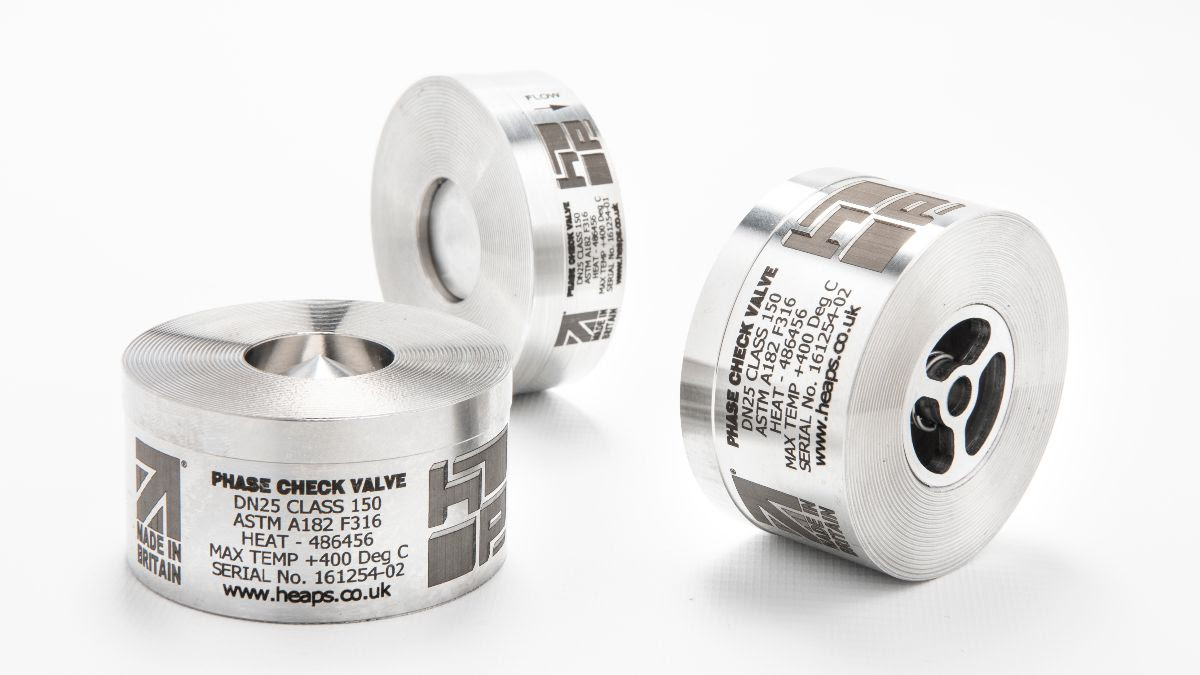
Phase Check Valves are designed for exactly these environments. They are not general-purpose components – they are engineered for demanding industrial service.
Choosing the Right Check Valve Design
Not all check valves work in the same way, and the right choice depends on your specific operating conditions. Here is how the main types differ and when each one is the better option.
Sprung Disc Check Valves
This is the core of the Phase check valve range. In a sprung disc design, forward flow pushes the disc off its seat against a calibrated spring. The moment flow stops or drops below the cracking pressure, the spring drives the disc back onto its seat immediately, before any reverse flow has the chance to occur.
Because closure is driven by the spring rather than gravity, sprung disc valves can be installed in any orientation – horizontal, vertical, or angled – which gives you much greater flexibility when you are routing pipework in a congested area. They are the right choice wherever rapid, reliable closure is important.
Swing Check Valves
A swing check valve uses a hinged disc that swings open under forward flow and closes under gravity and back-pressure when flow stops. This design works well in larger bore lines with lower flow velocities and relatively clean media, where rapid closure is less of a priority. The lower pressure drop across a swing check compared to a sprung disc design makes it a practical choice for general water and utility service applications.
Non-Return Valves
Non-return valves cover a broader category of backflow prevention designs and are commonly specified where the main requirement is straightforward – stop reverse flow -without a specific need for tight cracking pressure control or fast closure. When deciding between these types, the key factors to work through are your flow velocity, the orientation of the pipe, how quickly the valve needs to close, and what the consequences would be if reverse flow did occur even momentarily.
Phase Check Valve Specifications
Our standard stocked Phase Check Valves are available in Class 150 and Class 300 pressure ratings, in sizes from 15mm up to 100mm. The standard body material is 316 stainless steel with an Inconel spring, which gives you good corrosion resistance and thermal performance across a wide range of process conditions.
If your application requires something outside the standard range – an exotic alloy body, a non-standard pressure rating, or a specific end connection – we manufacture to order. If you are unsure what you need, our technical team can work through the specification with you based on your operating conditions and media.
Phase Distribution Manifolds: Simplifying Multi-Point Supply
If your system needs to distribute instrument air, process gas, or another utility medium to multiple instruments or actuators from a single supply, a distribution manifold is a far better solution than assembling a network of T-junctions and individual fittings.
You may also hear these referred to as air headers, which is the common plant term when instrument air is the primary medium being distributed. Whatever the terminology on your site, the principle is the same: a single engineered block takes in the supply at one end and splits it cleanly to however many outlets you need.
The practical benefits of this approach are significant. Every T-junction or threaded fitting you replace with a manifold is a potential leak path removed from the system. The installation is quicker, the layout is cleaner, and maintenance is considerably easier because everything is in one place rather than spread across a series of field-assembled joints.
How Phase Manifolds Are Specified
Phase Distribution Manifolds are custom-built to your requirements. The key things we need to know when helping you specify one are:
- How many outlets you need and what connections they require
- Whether you need individual isolation valves on any or all of the outlets
- The medium being distributed and its pressure and temperature conditions
- The material specification – standard stainless steel or an exotic alloy for more aggressive service
Because the manifolds are machined from solid bar stock or forgings, the metallurgical integrity of the finished component is consistent throughout. There are no cast sections, weld seams, or assembled joints in the body itself.
Using Check Valves and Manifolds Together
In many instrument and pneumatic systems, check valves and distribution manifolds are specified together as part of a single supply arrangement. The most common configuration is a supply line feeding into a Phase Distribution Manifold, with a Phase Check Valve fitted immediately upstream.
The check valve in this arrangement protects your primary supply line from back-pressure or contamination that might originate from the downstream instruments or actuators. The manifold then distributes the supply cleanly to multiple outlets. Together, they create a distribution hub that is isolated, protected, and easy to work on when the time comes for maintenance or modification.
Because both components are Phase products, you also get consistency in material certification, pressure rating documentation, and traceability across the whole assembly. That matters when you are putting together the documentation package for a new installation or responding to an audit.
Where Phase Products Are Used
Phase check valves and distribution manifolds are supplied into a wide range of industries across the UK and internationally. Typical applications include:
- Oil and Gas: Topside and subsea applications involving aggressive media, sour service conditions, and high-pressure gas systems.
- Chemical Processing: Safe distribution of utility gases and process media with reliable prevention of cross-contamination between streams.
- Power Generation: Steam systems, cooling water circuits, and utility distribution headers where long-term reliability is essential.
- Water Treatment & Utilities: Protection of pumps, compressors, and instrumentation from backflow damage across municipal and industrial water infrastructure.
- Pharmaceuticals: Clean, traceable flow control for processes where material certification and process integrity are non-negotiable.
Talk to Us About Your Application
Whether you need a standard stocked item or something built to a specific requirement, our technical team is set up to help you get the specification right. We manufacture the Phase range in-house, so we are not reliant on lead times from a third party when you need something non-standard.
Get in touch with your line size, pressure class, media details, and any specific end connection or material requirements and we will come back to you with sizing recommendations, material options, and full certification documentation. You can explore the Phase range on our website or call our team directly to discuss your project.