

Trunnion ball valves suit applications where pressure, size, sealing requirements or operating conditions move past what a floating ball valve handles comfortably. Both designs use a rotating ball for quarter-turn isolation, but they carry process loads very differently, and that difference drives everything else about the specification.
Trunnion Versus Floating: What Actually Changes
In a floating ball valve, the ball connects to the stem but is not rigidly supported at its lower end. Differential pressure pushes it towards the downstream seat, which helps create the seal. That works well across most general industrial duty, particularly at smaller sizes and moderate pressure.
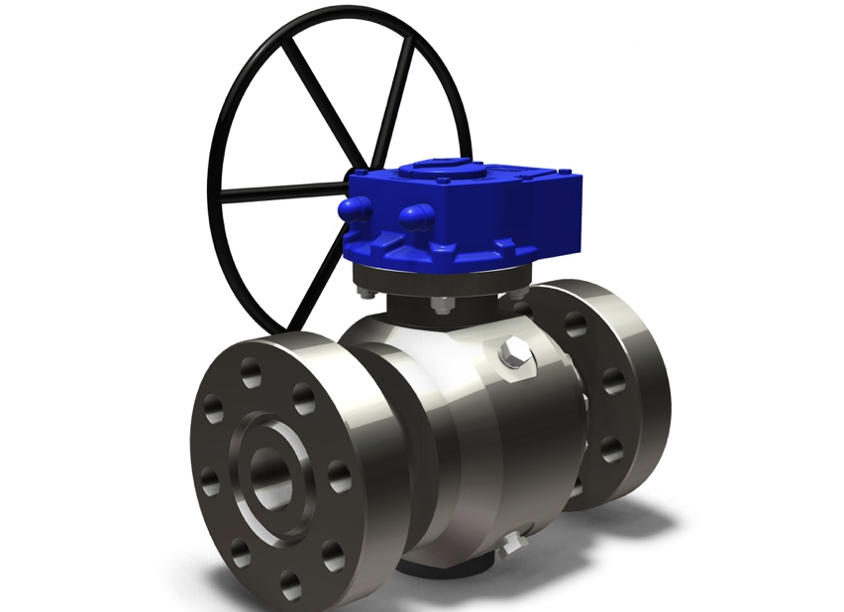
A trunnion ball valve supports the ball mechanically, located by the stem at the top and a trunnion at the bottom. The ball stays substantially fixed, and the seats move towards it instead. That separates two jobs cleanly: the trunnions support and locate the ball, while the seats generate the sealing force.
Why it matters as valves get bigger. A larger ball presents more area to the process pressure, and as pressure rises, the force across that area rises with it. In a floating valve, all of that load ends up in the downstream seat, which increases seat loading and operating torque. Eventually the combination of size and differential pressure makes a floating arrangement impractical, or at least needlessly heavy on operating loads. A trunnion design routes those forces through the valve structure instead and seals with independently energised seats.
There is no single size or pressure class where every application must switch. The crossover depends on bore, differential pressure, seat material, temperature and the manufacturer’s allowable limits. Take the answer from the pressure-temperature ratings and the project specification, not from a rule of thumb about diameter.
Spring-Energised Seats and Sealing Behaviour
Because the ball is supported, the seats have to move towards it to seal. Trunnion seats combine spring force with process pressure: the springs provide initial contact at low differential, and as line pressure rises, it acts on the seat assembly to increase the force pushing it against the ball. That maintains sealing across a wide pressure range without relying on the ball moving at all.
Single piston effect (SPE)
An SPE seat is arranged so upstream line pressure pushes it towards the ball. If pressure becomes trapped in the body cavity and rises far enough above line pressure, that differential moves the seat away from the ball and lets the cavity relieve back into the pipeline. This self-relieving behaviour matters wherever temperature change can make trapped fluid expand.
Double piston effect (DPE)
A DPE seat can be driven towards the ball by pressure from either the pipeline or the body cavity. That gives an additional sealing barrier, but it changes how cavity pressure has to be managed, because the seat will not self-relieve.
Cavity relief is now an explicit requirement. Addendum 3 to API 6D states that where liquid trapping is possible, the valve shall be provided with automatic cavity relief, and for temperatures up to 250 degrees F the cavity relief pressure shall not exceed 33% differential above the valve pressure rating. If you specify DPE seats, you need to say how the cavity is relieved.
The right arrangement follows from your isolation philosophy, pressure direction, cavity relief strategy and project specification. Our Phase range covers single and double piston seating, full and reduced bore, in soft and metal seated side entry designs. Our standard metal seat specification uses HVOF or CVD tungsten carbide, or a Stellite-based fusion bonded coating, which stands up well to solids and abrasive flow.
Double Block and Bleed: What DBB Actually Means
DBB is specified constantly for pipeline isolation and used loosely almost as often. In a trunnion valve configured for DBB, the two seats provide separate sealing barriers, and the body cavity between them can be vented or drained, so you can isolate pressure and then use the cavity connection to verify what is happening between the seats.
DBB is a defined valve and seat function, not another name for any trunnion ball valve. The actual isolation behaviour depends on seat design, pressure direction, valve configuration, test conditions, the applicable standard and the condition of the sealing surfaces.
Opening the body bleed helps demonstrate whether pressure is passing a seat. It does not make leakage impossible, and DBB is not interchangeable with every other form of double isolation. API 6D addresses double block and bleed and double isolation and bleed separately, so write down the isolation behaviour you actually need rather than relying on the abbreviation. Phase trunnion valves come in single isolation and DBB designs, and go into offshore duties including ESDV, SDV, HIPPS, manual isolation and motor operated valves.
Fire-Safe Certification and Secondary Sealing
For isolation valves on hydrocarbons and other flammable fluids, fire-safe performance is often non-negotiable. A fire-safe valve is designed and tested so that if fire damages its soft sealing components, it still limits through-seat and external leakage within the requirements of the test standard.
ISO 10497:2022 specifies fire type-testing for soft-seated and metal-seated isolation valves, covering through-seat leakage, external leakage, cavity overpressure relief and operability through the defined sequence. Designs achieve this with features such as secondary metal-to-metal contact and fire-resistant stem and body sealing, so losing a soft seat does not remove every barrier at once.
Read the certificate, not the phrase. Fire-safe qualification demonstrates performance under a defined test. It does not mean the valve emerges from a fire undamaged or keeps working indefinitely. Our Phase trunnion range is designed in accordance with API 6D and fire-safe certified to ISO 10497, backed by an extensive fire testing programme covering seat styles, seal types and materials of construction rather than a single representative valve.
API 6D: What It Covers
API Specification 6D is the central standard for valves in oil and gas service. It defines requirements for design, manufacturing, materials, welding, quality control, assembly, testing, marking, documentation and process controls across axial, ball, check, gate and plug valves, and applies to ASME Class 150 through to 2500.
Record the edition and the addenda, not just “API 6D”. The current edition is the 25th, published November 2021, with Addendum 3 issued in March 2025 and a Monogram effective date of September 2025. A project document, inspection plan or approval file may reference a fixed edition, and a valve can match the duty perfectly and still create a documentation problem if the purchase order, ITP and nameplate point to different editions.
This is also why an enquiry saying only “API 6D ball valve” is incomplete. The standard is the framework; your project specification defines the valve that has to work inside it.
Materials for Sour, Corrosive and Subsea Service
Trunnion valves tend to be chosen for duties that also demand more from the materials. Carbon steel suits many applications, but corrosive fluids, seawater exposure, hydrogen sulphide and aggressive production environments push you towards stainless steels, duplex and super duplex, nickel alloys, corrosion-resistant weld overlays or higher-alloy trim. Consider the external environment as well as the process fluid.
For sour production service, material selection may also need to satisfy ISO 15156 for H2S-containing environments, which addresses selection and qualification of materials against cracking mechanisms including sulphide stress cracking and stress corrosion cracking.
We work in these materials within the Phase range, including Inconel overlays and duplex and super duplex alloys, and we run our own positive material identification gun to verify materials of construction rather than rely on paperwork alone. A 4-inch reduced bore Class 600 valve in solid F44 6-moly for a North Sea turnaround also needed API 6D and high-pressure gas testing plus a full offshore paint specification, and left our factory in nine weeks. Selection rarely stops at size and pressure class.
In Practice: Phase Trunnion Valves for the Bruce Field
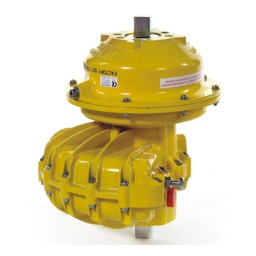
For a Serica Energy maintenance campaign, we designed and manufactured twelve Phase trunnion ball valves at Birkenhead for the Bruce Field facilities in the UK North Sea. Several were supplied as actuated packages for emergency shutdown duty on the platform.
The point is not the size of the valves. It is that a large offshore isolation valve has to resolve high mechanical loads, reliable seat sealing, project-specific materials, offshore environmental conditions, inspection and testing, emergency shutdown requirements and full manufacturing and documentation control, all at once. At that stage you are no longer choosing a catalogue valve; the valve has become engineered equipment, and the trunnion design is the platform the rest of the specification sits on.
Subsea work pushes further again. We have manufactured Phase subsea ball valves in Britain for a major Caspian Sea project, where corrosion resistance, external coatings, pressure testing, stem and seal integrity and long-term reliability all matter more because nobody can reach the valve to maintain it. More on our work in oil and gas and our UK manufacturing capability.
If the valve also needs automating, treat actuator sizing as a separate engineering decision. See our actuated ball valve selection and sizing guide for torque, fail-safe operation, mounting and control.
What to Send Us
For anything high pressure, corrosive or unusual, send the valve datasheet and project specification. Otherwise, as much of this as you have:
- Process fluid and composition
- Nominal size, full or reduced bore, and pressure class
- Operating and design pressure and temperature
- End connection type
- Required seat arrangement, SPE or DPE
- Isolation philosophy, including DBB or DIB where applicable
- Soft or metal seat requirement
- Fire-safe and sour service requirements
- Body, ball, stem and trim materials, and any CRA overlay
- Testing and inspection requirements
- Subsea or topside installation
- Operating method, documentation requirements and delivery date
Talk to Us About a Trunnion Ball Valve
A trunnion valve becomes necessary when the demands on the valve itself change. Higher pressure and larger bore raise the loads to be controlled, critical isolation brings specific seat and DBB requirements, and fire-safe, sour and subsea service add further demands on materials, sealing and testing.
We design and manufacture our own Phase trunnion-mounted ball valves in the UK. Send us the process conditions, size, pressure class, materials, isolation philosophy and applicable testing standards, and we will help define the specification.